Tiếng Việt
Do you frequently experience heavy eyelids and drooping eyelids, making your face look tired and lifeless? This could be a sign of levator palpebrae fascia – a fairly common condition, but one that many people confuse with ordinary ptosis. Besides affecting aesthetics, levator palpebrae fascia can also hinder vision if left untreated. So what are the causes and effective solutions? Let’s explore the details in the article below from Dr Xuan Quan Clinic.
What is levator muscle weakness?
Levator palpebral muscle weakness is a condition where the levator palpebral muscle (the muscle that helps open the eyes) is weakened or ineffective, preventing the eyelids from fully lifting.
You can recognize levator palpebral muscle weakness through the following signs:
- Drooping eyelids, partially covering the pupil: This restricts vision, especially in severe cases.
- Uneven eyes: One eyelid may droop more noticeably than the other.
- Constantly tired eyes: Even after resting, the eyes still lack vitality.
- Needing to use forehead force to open the eyes: Many people have a habit of raising their eyebrows to compensate for the weak eyelid lifting force.
This is a form of levator palpebral muscle weakness that needs to be differentiated from ptosis caused by sagging skin or aging.
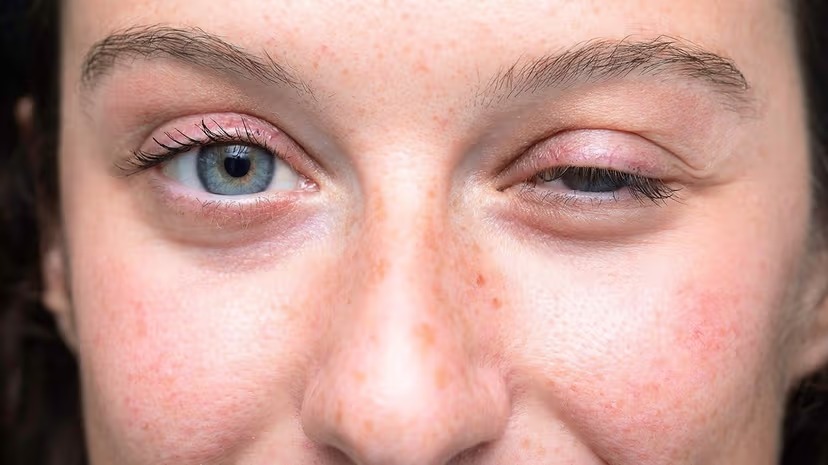
Causes of levator muscle weakness
The condition of levator muscle weakness can stem from various causes, including both congenital and external factors:
- Congenital: Weak levator muscles from birth prevent the eyelids from opening fully, leading to persistent ptosis (drooping eyelids) from childhood.
- Aging: Over time, the muscles and skin around the eyes gradually weaken, losing elasticity, reducing the eyelid’s ability to support itself and causing levator muscle weakness.
- Nerve damage: Damage to the nerves controlling the levator muscle reduces its function, causing the eyelids to droop.
- Post-cosmetic surgery complications: Incorrect levator muscle surgery or eyelid lifting techniques can damage the levator muscle, leading to muscle weakness and the inability to lift the eyelids normally.
Is levator muscle weakness dangerous?
Besides affecting appearance, levator muscle weakness can also cause many negative impacts on health and quality of life if not treated promptly:
- Reduced vision (in severe cases): When the eyelid droops, partially covering the pupil, vision can be limited, making daily activities difficult.
- Prolonged eye strain and discomfort: Due to weak levator muscle function, the eyes have to adjust more, leading to fatigue and tension in the eye area.
- Dull and unbalanced facial appearance: Drooping eyelids make the eyes look smaller and less expressive, making the overall face look less vibrant and unbalanced.
- Psychological impact and lack of self-confidence: The condition of levator muscle weakness makes many people feel self-conscious when communicating, especially in work and daily life.
Effective methods to treat levator muscle weakness
Depending on the severity and cause, levator palpebrae can be improved using various methods:
Eyelid surgery
Eyelid creasing is a procedure that creates eyelid creases using cosmetic sutures, helping to slightly improve the appearance of indistinct eyelids due to unstable levator muscle function.
- Minimally invasive, no surgery required: Quick procedure, minimal pain, and short recovery time.
- Suitable for mild myasthenia gravis: Applied when the levator muscle is not significantly weakened and eyelid drooping is not yet pronounced.
- Temporary results: Because it does not directly interfere with the levator muscle, it needs to be repeated after a period of time to maintain the results.
Eyelid surgery combined with eyelid lift
This method directly intervenes in the levator muscle – the core factor causing levator muscle weakness.
- Direct impact on the levator muscle: The doctor will adjust the function of the levator muscle, helping the eyelids open more naturally and flexibly.
- Complete correction of drooping eyelids: Significantly improves the degree of eye opening and balances the eyelids for a more harmonious appearance.
- Combined treatment of sagging skin and excess fat: Helps the eyelid area look neater, younger, and more defined.
- Improves both function and aesthetics: Not only makes the eyes more beautiful but also supports vision, especially in cases of ptosis affecting eyesight.
This is considered the most effective method for treating levator muscle weakness, especially in moderate to severe cases.

Address for specialized and safe nose and eye cosmetic surgery
Dr. Xuan Quan Aesthetic Clinic brings together a team of doctors with deep expertise in the field of eyelid surgery, with over 10 years of clinical practice experience. The doctors directly examine and analyze the structure of the eyelid skin, levator muscle, excess fat, and degree of aging before prescribing the appropriate method.

Factors contributing to the reputation of Dr Xuan Quan Clinic:
- Specialist doctors directly examine and perform surgery: Thorough assessment of eye structure, appropriate intervention, minimizing the risk of eyelid surgery being too large or asymmetrical.
- Personalized eyelid crease design: Adjusting the height and curvature to suit each face, avoiding fixed eyelid shapes.
- Modern equipment: Supporting precise dissection and suturing, reducing the risk of scarring and complications.
- Standard medical procedures and strict sterilization: Risk control from the outset, ensuring safety during and after surgery.
Meticulous post-operative care: Detailed instructions, suture removal after 7 days, and regular follow-up appointments ensure long-term stable results.
All services use high-quality materials (for surgeries with supporting materials), a clear 6-month warranty policy, combined with standard medical procedures and a systematic post-operative care regimen.

Currently, Dr. Xuan Quan Aesthetics offers a variety of solutions tailored to different ages and eye conditions:
|
Service |
Specific services |
Price ($) |
| Upper eyelid surgery | Upper eyelid surgery / Lower eyelid lift (<40 years old) | 300 |
| Upper eyelid surgery (40-49 years old) | 340 | |
| Upper eyelid surgery (50-59 years old) | 380 | |
| Upper eyelid surgery (≥60T) | 410 | |
| Eyelid surgery | Eyelid surgery | 190 |
| Remove the sutures from the eyelid lift | 70 |
All services utilize high-quality materials, come with a 6-month warranty, and last 5-10 years. They combine standard medical surgical procedures with close post-operative monitoring. Sutures are removed after 7 days, shortening recovery time and allowing patients to return to normal activities sooner.
Frequently asked questions about levator palpebrae
When experiencing levator muscle weakness, many people often wonder about the extent of the problem, the possibility of treatment, and especially the surgical methods. Below are detailed answers:
Can levator muscle weakness resolve on its own?
No. If the cause is due to weak levator muscles or a congenital condition, this condition will not improve on its own without intervention.
Is levator muscle weakness surgery dangerous?
If performed at a reputable facility with a highly skilled doctor, this method is safe, has few complications, and provides noticeable results.
Is levator muscle weakness surgery painful?
The procedure is performed under local anesthesia, so it is virtually painless. After surgery, there may only be mild discomfort for the first few days.
How long is the recovery time after surgery?
- 7-10 days: suture removal
- 2-4 weeks: swelling subsides, basic recovery
- 1-3 months: eyelids stabilize naturally
Will there be scarring after surgery?
If performed correctly, the scars are very faint and almost invisible after recovery.
Can the surgery recur?
If the underlying cause is properly addressed and good aftercare is provided, the results can be long-lasting.
Leptospasm not only affects aesthetics but also directly impacts vision and quality of life. For safe, natural, and long-lasting results, you should seek treatment at a reputable facility like Dr. Xuan Quan Aesthetic Clinic, where you can completely overcome ptosis and regain balanced, harmonious eyes.