Tiếng Việt
After eyelid surgery, many people hope to have big, round, natural-looking eyes. However, in many cases, the incisions are too deep, making the gaze look harsh, sunken, or unbalanced. So what are the causes? Can it be corrected? Let’s find out in detail in the article below from Dr Xuan Quan Clinic.
What does it mean for eyelid surgery to result in deep creases?
Deep eyelid creases after surgery are a condition where the eyelid crease is too deep, prominent, making the eyes look harsh, unnatural, or asymmetrical.
This condition may be temporary in the initial stages due to swelling and tissue contraction after surgery. However, if the crease remains deep, stiff, and lacking softness after recovery, it is usually no longer normal.
- It is considered temporary if the eyelids are newly operated on, the tissue is still swollen, and the crease has not yet fully stabilized.
- It is no longer normal if the deep crease persists, the crease is prominent, lacks softness, or the two sides are asymmetrical.
- Early intervention is not recommended while the eyelid tissue is still recovering, as assessment at this time is prone to inaccuracies.
- A specialist consultation is necessary if the deep eyelid crease does not improve over time or significantly affects aesthetics and eye opening function.

Reasons why eyelid surgery results in a deep crease
Deep eyelid creases after surgery don’t usually happen randomly; they stem from errors in design, technique, or initial assessment of the eye structure. Here are the five most common causes:
- Designing the crease too high for the facial proportions: When the crease is created beyond the natural structure of the eye, the distance from the lash line to the crease is too large, making the eyes look sunken and lacking softness.
- Removing too much upper eyelid fat: Eyelid fat plays a role in filling the eye socket. If too much is removed, the upper eyelid area is prone to sunkenness, revealing the deep eyelid crease after the swelling subsides.
- Incorrect intervention of the levator muscle: Over-manipulating the levator muscle or unevenly on both sides can cause the eyelid to be pulled up abnormally high, creating a deep and stiff appearance.
- Thin skin or pre-existing deep eye sockets: Individuals with naturally deep eye sockets, thin skin, or little connective tissue, if not carefully considered before surgery, are at a higher risk of developing deep eyelid creases after the procedure.
- Performed at a facility lacking expertise: Lack of experience in anatomical assessment and personalized design is a major cause of unsuitable eyelid shape, increasing the risk of deep or asymmetrical eyelid incisions.
Identifying the correct cause will help the doctor develop an appropriate corrective plan and minimize risks during or after the procedure.
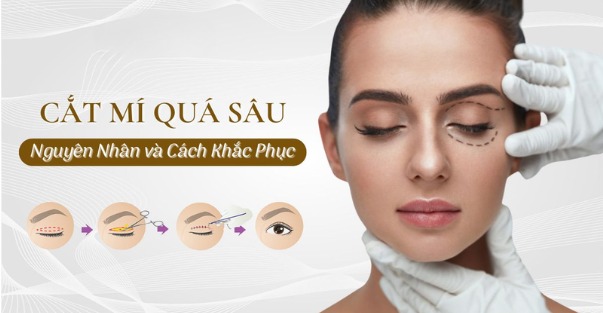
Signs that require early intervention when eyelid surgery results in deep indentation
Not all cases of deep eyelid creases require immediate correction. However, if you experience any of the following signs, you should seek early examination for timely assessment and intervention:
- The eyelid crease is too deep, clearly visible, and shows no signs of softening over time.
- The eyelids are noticeably asymmetrical, unbalanced when opening or closing.
- The eyes appear wide open, cannot close completely, or are dry and irritated for an extended period.
- There is an unusually prolonged feeling of tightness or pulling in the eyelid area.
- The eyelids feel stiff and unnatural, significantly affecting facial expressions.
- The eyelids droop, the eyes open weakly, or there is suspicion of damage to the levator muscle.
Professionally, these are signs that the eyelid crease may be fixed too deeply, the tissue is excessively pulled, or the eyelid structure has not been properly addressed. A timely examination will help the doctor determine if further monitoring is needed or if corrective intervention is necessary to prevent the condition from worsening.
How to fix the problem of deep eyelid surgery
Deep-set eyelids can be improved if the cause is properly assessed and intervention is done at the right time. Here are some common treatment approaches:
- Monitoring if swelling persists: In the first 1-2 months, the eyelids may appear deeper due to tissue contraction. It’s advisable to wait 8-12 weeks for accurate assessment before revision.
- Adjusting the eyelid crease: If the cause is an overly high eyelid design, the doctor can lower and reshape the eyelid to create a more balanced and softer look.
- Adding volume to the eyelid area: In cases where excessive fat removal causes sunken eye sockets, autologous fat grafting may be considered to increase natural fullness.
- Reconstructing the eyelid structure in complex cases: With tissue contraction or stiff eyelids, specialized intervention is needed to release the scar and readjust the levator muscle.
Choose a reputable clinic for cosmetic eye surgery
Dr. Xuan Quan Aesthetic Clinic is trusted by many clients thanks to its team of highly specialized eye surgery specialists who directly examine and perform surgeries. With practical experience in numerous eye cosmetic procedures, from basic to corrective eyelid surgeries, each surgery here is designed with a personalized approach, prioritizing safety, accuracy, and long-lasting results.
- Specialized Eye Surgery Specialists: Accurately analyze the anatomical structure of the eyelid area, control the appropriate tissue dissection, and minimize damage to blood vessels – a factor that can increase the risk of severe bruising after eyelid surgery.
- Modern Equipment: Supports clear tissue dissection, precise manipulation, and meticulous cosmetic suturing to reduce the risk of scarring and prolonged post-operative bruising.
- Standard Medical Procedures: Sterile operating rooms and strict adherence to surgical safety procedures minimize post-operative risks.
- Close Post-operative Monitoring: Sutures are removed after 7 days, and recovery progress is monitored regularly. Results last an average of 5-10 years depending on individual factors, with a 6-month warranty as per regulations.
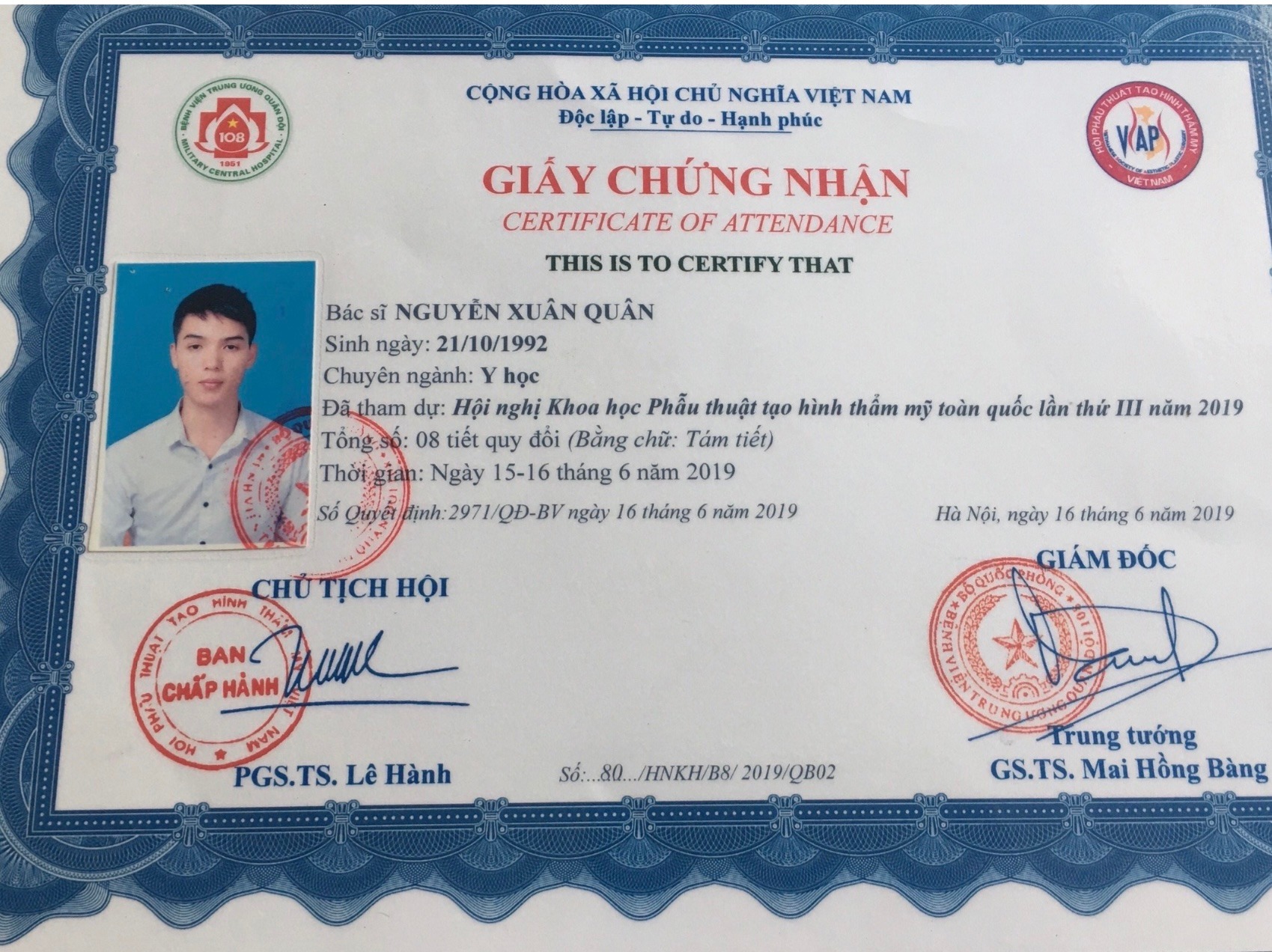
Currently, Dr. Xuan Quan Aesthetics offers a variety of solutions tailored to different ages and eye conditions:
| Category | Specific services | Price |
| Upper eyelid surgery | Upper eyelid surgery / Lower eyelid lift / Under 40 years old | 300$ |
| Upper eyelid surgery (40–49 years old) | 340$ | |
| Upper eyelid surgery (50–59 years old) | 380$ | |
| Upper eyelid surgery (≥60T) | 418$ | |
| Eyelid surgery | Difficult eyelid surgery (eyelid revision, scarred eyelids, drooping eyelids) | 450$ |
| Lower your eyes wide open | Lowering the head | 570$ |
| Eyelid fat grafting | Eyelid fat grafting | 300$ |
| Lower eyelid surgery | Chin muscle blepharoplasty – Lower eyelid lift with fat repositioning | 570$ |
| Eyebrow lift | Eyebrow lift and frontal muscle suspension | 450$ |
| Eyebrow lift | 300$ | |
| Eyelid surgery | Eyelid surgery | 190$ |
| Remove the sutures from the eyelid lift | 70$ |
All services utilize high-quality materials, come with a 6-month warranty, and last 5-10 years. They combine standard medical surgical procedures with close post-operative monitoring. Sutures are removed after 7 days, shortening recovery time and allowing patients to return to normal activities sooner.

The question relates to the condition of eyelid surgery resulting in a deep incision
Below are some frequently asked questions about deep eyelid surgery, to help you understand better before deciding on treatment or correction:
How long does it take for eyelid surgery with deep indentations to stabilize?
Typically, after 4-8 weeks, the eyelid swelling will subside and the eyelid will begin to settle into its final shape. However, to accurately assess whether the incision is truly deep, it’s best to wait approximately 8-12 weeks until the soft tissue has completely stabilized.
Can deep indentations after eyelid surgery heal on their own?
If the cause is mild swelling or tightness after surgery, the condition may gradually improve over time. However, if it’s due to the eyelid crease being too high or too much fat being removed, the eyelids will be difficult to fill in on their own and will require professional intervention.
How long does it take to correct sunken eyelids?
The safest time for revision surgery is usually after 3-6 months, depending on individual factors and recovery rate. Intervention too early, before the tissue has stabilized, can increase the risk of complications.
Is correcting sunken eyelids complicated?
Correcting botched eyelid surgery is often more complex than the initial surgery because the tissue structure has been altered. The surgeon needs to address scar tissue, readjust the eyelid crease, and may add tissue if there is a deficiency.
Deep eyelid incisions can be a temporary post-operative reaction, but it can also be a sign of over-intervention. A timely examination will help accurately determine the condition and choose the appropriate treatment. If you are experiencing deep eyelid incisions, you should consult a specialist in cosmetic eye surgery for assessment and advice on safe and effective solutions.